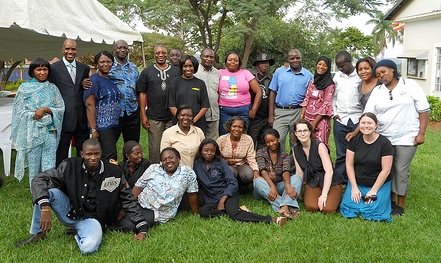
A four-year, $2.5 million IWMF program has transformed the reporting of agriculture and rural development in Africa and given voice to rural women farmers.
"This program has not only changed how reporting on agriculture is conducted in the six media organizations, but it has transformed the careers of trainees who now approach reporting on all the topics they cover in a different way," said Elisa Munoz, IWMF’s director of programs who has overseen the project.
IWMF staffers Alana Barton and Nadine Hoffman traveled to Kampala, Uganda in late May, 2011 for the final meeting with participants in the IWMF’s
Reporting on Women and Agriculture: Africa (RWA) program. The dominant role of women in agriculture was overlooked until this program trained reporters to cover this area.
Since the program began, RWA participants in Mali, Uganda and Zambia have become respected leaders in their newsrooms and have set a new standard for reporting on issues of agriculture and rural development, their supervisors reported at the program’s closing session.
The final forum focused on assessing outcomes and sustainability of RWA, which was designed to increase and enhance reporting on the role of women and agriculture. The program was funded by the Howard G. Buffett Foundation.
Patrick Luganda, IWMF’s trainer in Uganda, said of his trainees, "They know exactly what to do. They know they’ve got to source the stories, go out to the field, do their homework, interviews and research…all the skills we taught have been put into practice."
Trainees have also begun an informal mentoring system in their newsrooms, and they are viewed by their colleagues as true experts.
"My position has changed," Ellen Hambuba of the Zambia National Broadcasting Corporation (ZNBC) – one of six participating media organizations explained. "My editors know that because of the training I’ve acquired more skills, and I’m able to share the knowledge with colleagues and advise them. I’ve become an expert."
Zambian trainer Susan Musukuma expressed great expectations for Hambuba and her counterparts at ZNBC and the
Times of Zambia. "I’m very sure that in the long term…these women will be in key positions in the media in Zambia."
The depth and breadth of reporting on women and agriculture, particularly in rural areas, has increased dramatically as a result of the program. "Between 2009 and now, it can be seen that agriculture has assumed an important place," Malian trainer Mahamane Hameye Cisse said.
The trainees’ reporting "gives an authoritative voice to women," Luganda said. "Telling the story of a 34-year-old woman farmer with five children is to me a major milestone, because previously our stories were about the minister of agriculture and what he said."
Reuben Kajokoto, ZNBC’s director of programs, cited a shift in his newsroom’s editorial policy as a result of the RWA program. "Most of the news in the past only had a few voices from the rural area, so a deliberate move was made to get stories from rural areas. If you set your goals, you can actually get those voices that are not normally there."
Kajokoto added that the new editorial policy is good for business. "When you cover a wider spectrum of people, you are likely to get more sponsors," he explained.
Advertising revenues at participating media organizations increased due to agriculture themed weekly pullouts and programs that have attracted loyal advertisers.
Times of Zambia editor Miriam Zimba said that on Mondays, the day the paper’s agriculture page runs, they sometimes run a four-page supplement to fit all the related ads.